
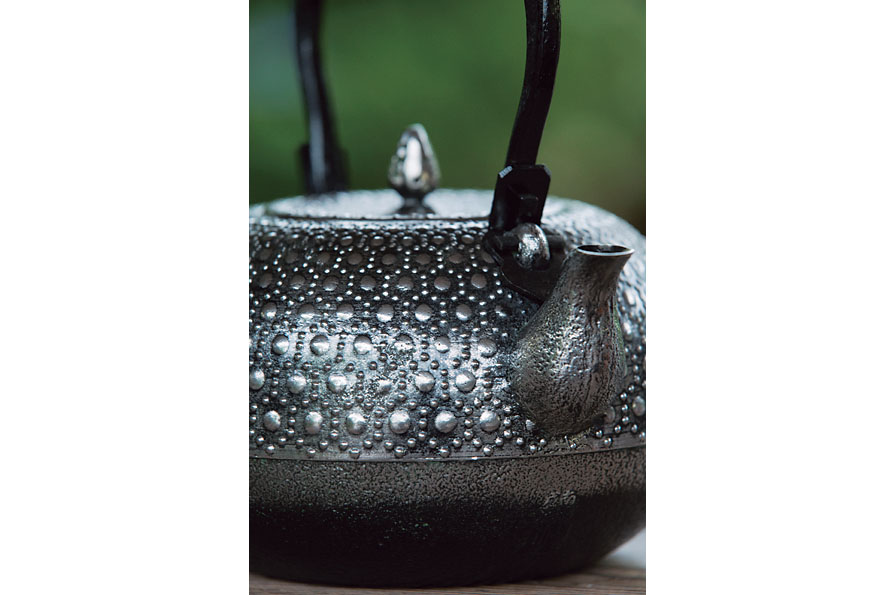

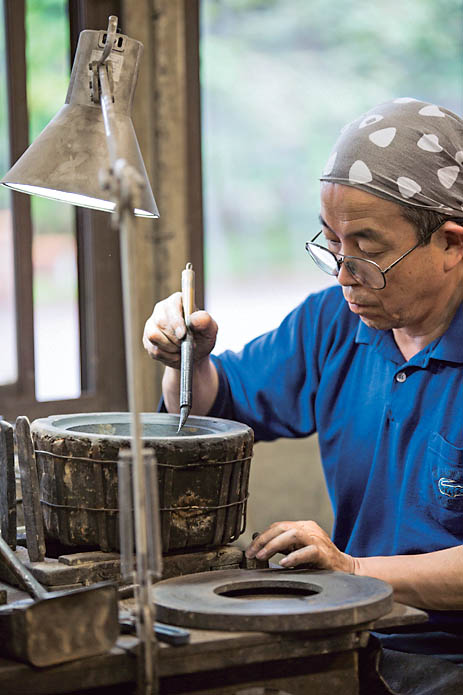
The pattern that defines Nambu iron kettles is created by artisans, who press a stick into a sand or clay mold to accurately create spots one by one. Molten iron is poured into the mold, and when the iron kettle shell is formed, lacquer and ohaguro (tooth blackening dye) are applied before it is fired. This finish is the secret behind its durability and distinctive controlled-gloss texture.
The origin of Nambu Tekki ironware dates back about 400 years, when Nobunao Nambu established the Nambu Domain in Morioka. Its successive lords had a great interest in culture and started to make kettles for use in the tea ceremony after learning techniques from Kyoto and Koshu districts. However, since only a few people, basically the samurai, had any interest in the tea ceremony, these tea ceremony kettles, even if they were highly praised as offerings and such, played little role in the daily life of the common people. It is said that their use as an everyday item spread instantly among people when a spout and a handle were added, effectively turning them into kettles.
Morioka has always been rich in good-quality iron resources, like iron sand and ironstone, and since all materials such as river sand, clay, lacquer and charcoal can be procured locally, it is a land suited for making cast iron products. Traditional techniques nurtured in this area gained popularity in Paris, and there is currently a global craze for the Nambu Tekki ironware. Not only kettles, there are now a variety of items with modern designs such as cast iron pots and frying pans. By adding contemporary conceptions to these high-level casting techniques, this 400-year-old traditional craft and spirit has gone global. This is probably the key to the continued love felt for these daily-life goods.
